

Workforce Blueprint for AI, jointly authored by JA Asia Pacific, the JA Institute, and Ecosystm, finds that young people entering the workforce risk falling behind in AI adoption and outlines a roadmap for governments, educators, employers, and youth to prepare for the future of work
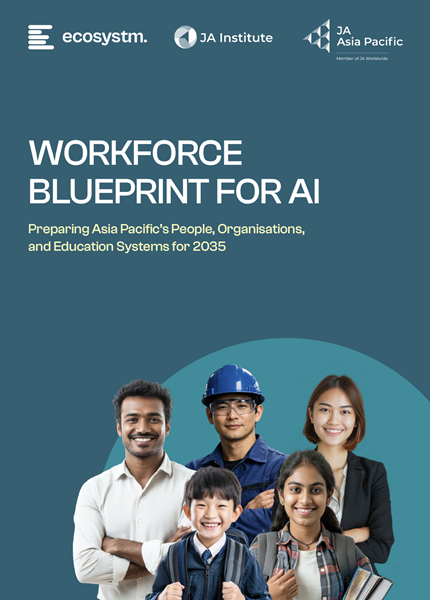
NEW YORK, Sept. 21, 2026 (GLOBE NEWSWIRE) -- JA (Junior Achievement) Asia Pacific, JA Institute, and Ecosystm today launched Workforce Blueprint for AI, a position paper calling for coordinated action to ensure Asia Pacific’s workforce is prepared for an AI-enabled future. The report cautions that, although AI adoption is accelerating across the region, work readiness is not keeping pace, creating a growing gap likely to widen inequality and constrain economic opportunity for youth.
Developed under the guidance of the JA Asia Pacific AI Council, the paper introduces a “three horizons” framework that examines how work is likely to evolve in phases through 2035, from AI-assisted productivity and role redesign to AI-orchestrated operations and, ultimately, interconnected human-AI ecosystems. It argues that work readiness cannot be defined solely by AI literacy or via proficiency with individual tools.
Instead, long-term success will depend on building durable skills, such as critical thinking, creativity, judgment, adaptability, collaboration, and problem solving. The report identifies four strategic challenges facing the region's workforce transition: the growing AI readiness divide between countries, communities, and businesses; the need to build the workforce capabilities required to support AI infrastructure; the challenge of translating AI investment into productivity and innovation; and the transformation of entry-level work as AI takes on more routine tasks.
“AI adoption is likely to advance more rapidly than workforce readiness. With the largest youth population in history, Asia Pacific has a unique opportunity to connect today's classrooms to tomorrow's workplaces. This Blueprint is designed to help governments, employers, educators and young people turn AI driven change into an economic and social dividend rather than a source of disruption,” said Dr. Vivek Kumar, President and CEO, JA Asia Pacific.
Asia Pacific will play a defining role in the future of AI and work. Home to 700 million young people, along with many of the world’s largest economies and fastest-growing digital markets, the region may appear to have significant advantages in the AI transition. Yet countries are entering this transformation from vastly different starting points, with varying levels of digital maturity, infrastructure, education capacity, and workforce readiness. Without deliberate action from government and non-governmental agencies, educational institutes, and employers, these differences risk becoming a new source of economic inequality.
“The future of work will not change at one speed or in one direction,” said Amit Gupta, Group CEO of Ecosystm and a member of the JA APAC AI Council. “As it becomes increasingly difficult to train for specific jobs and technologies, organizations and educational systems need practical frameworks that help them build capabilities that remain valuable as work evolves. The “three horizons” framework provides a way to do exactly that.”
The paper highlights how AI’s impact will vary significantly across industries. Ecosystm research found that 43% of financial services organizations have incorporated AI into their business strategies compared with 20% of manufacturing organizations, while 41% report live AI initiatives compared with 17% in manufacturing. The findings illustrate that there is no single pathway to AI adoption and that workforce planning must reflect industry-specific realities.
The report recommends that education systems continue to shift from developing static skills to building durable skills, enduring capabilities and lifelong learning pathways. It calls for adaptive curricula, stronger educator preparedness, AI literacy and capability across disciplines, expanded industry partnerships, work-integrated learning opportunities, and more flexible pathways for continuous workforce development.
“Every young person deserves the chance to build a successful future, and that means preparing them for a world of work being reshaped by AI,” said Caroline Jenner, Chief Operating Officer of JA Worldwide. “Across Asia Pacific, young people are already imagining careers, developing skills, and making decisions that will shape their lives for decades to come. Workforce Blueprint for AI helps educators, policymakers, and employers understand the durable skills young people will need to navigate that changing landscape with confidence.”
The competitive advantages found across Asia Pacific will depend on its ability to continuously develop work readiness throughout the evolution of technologies, industries, and jobs. The report also calls on governments, employers, education providers, and learners to work together to close the gap between AI adoption and workforce readiness and ensure the benefits of AI are broadly shared.
Workforce Blueprint for AI launches during UN General Assembly High-Level Week, and kicks off with a panel today that features young people, AI experts, and educators, an affiliate event of the ITU-UNDP Digital@UNGA initiative. Download the report at ja.institute/ideas-papers.
About JA Asia Pacific, JA Worldwide, and the JA Institute
JA Worldwide is one of the world’s largest and most impactful youth-serving nonprofits, delivering more than 23 million hands-on, immersive student learning experiences each year across more than 120 countries. Through six regional operations—including JA Asia Pacific—the organization connects global scale with deep local expertise to equip young people with the skillset and mindset to build thriving communities. The JA Institute, an initiative of JA Worldwide, extends this work through research, thought leadership, and youth advocacy, generating and sharing insights that can strengthen opportunities for young people around the world. Visit jaasiapacific.org, jaworldwide.org, and ja.institute.
About Ecosystm
Ecosystm is a leading technology market analyst and advisory firm that helps stakeholders navigate innovation in the digital economy through data, insights, and expertise. We connect enterprises, technology companies, digital native founders, investors, and policymakers to enable informed decision-making. With ongoing research and access to top analysts and strategic advisors, we empower business planning, go-to-market activities, thought leadership, and innovation strategy consulting. Visit ecosystm.io.
A photo accompanying this announcement is available at https://www.globenewswire.com/NewsRoom/AttachmentNg/1bb0c782-4b19-4795-9f6f-cc52173868ba
Contact
Tere Stouffer
Chief Marketing Officer, JA Worldwide
+1-212-641-0747
tere.stouffer@jaworldwide.org
-
Smith+Nephew to showcase leading shoulder technologies for joint repair and reconstruction at ICSESSmith+Nephew (LSE:SN, NYSE:SNN), the global medical technology company, today announces it will highlight a suite of advanced solutions for shoulder2026-09-22
-
2026年9月最新上海联想官方售后维修服务网点地址与客服电话在2026年9月,如果您需要在上海寻找联想官方授权售后维修网点及电话热线号码,以下信息将为您提供详细的指南。本文将详细介绍查找上海联想官方授权售后维修服务网点2026-09-22
-
睿创微电子发布新型红外探测器封装方案——BCoS封装,让集成更简单高效2026年9月9日,在中国国际光博会现场,睿创微纳旗下探测器及模组品牌睿创微电子发布行业首创的全新封装方案——BCoS封装(bump chip on substrate)。目前,BCoS封装探测器2026-09-22
-
IDC评估中国 AI算力管理平台:范式综合评分位列第一 ,四项关键维度获满分中国北京 – Media OutReach Newswire – 2026年9月21日 – 全球知名的科技市场研究机构IDC发布最新《中国AI算力管理平台技术能力评估,2026》,对中国市场多家主流A2026-09-22
-
第十届特殊医学用途配方食品临床应用学术会议在渝举办 华森制药特医食品特易美与甘亦美获肯定2026年9月18日至19日,第十届特殊医学用途配方食品临床应用学术会议在重庆丽笙世嘉酒店成功举办。本次大会由中国营养保健食品协会指导,中国营养保健食品协会特殊医2026-09-22
-
AMD股价暴跌17%创近9年之最,苏姿丰紧急回应:AI增速远超想象
-
Ledger 中国销售渠道说明:广州馨潇贸易有限公司官方直营渠道公示
-
江苏省脑机接口产业联盟在宁成立,麦澜德分享前沿成果
-
艾芬达入选国家知识产权强国建设示范创建对象:二十载长期主义,兑现每一份用户价值
-
Esentia宣布成功完成2033年到期的6.125%优先票据和2038年到期的6.500%优先票据的定价
-
中荷人寿北京分公司成功举办中荷创享家品牌发布暨协同发展启航仪式
-
华为系具身智能公司具脑磐石完成新一轮融资:对标JEPA,押注类脑智能的认知世界模型
-
北京暑假补习班有哪些?家长首推一对一权威机构金博升学
-
上海高新技术企业代理机构深度访谈与推荐
-
2026 雷瓦亮相京东 MALL ,匠心筑造专业造型新标杆