

ISLAMABAD, May 30, 2026 (GLOBE NEWSWIRE) -- The Ministry of Information and Broadcasting (MoIB) is responsible for promoting and managing the official narrative surrounding Prime Minister Shehbaz Sharif's visit to China, which celebrates the 75th anniversary of diplomatic relations.
For most of the last decade, Pakistan-China engagement was defined in terms of highways, energy infrastructure, ports, and the broader CPEC-based infrastructure projects, all of which revolutionized Pakistan's economy, enhanced connectivity, and solved long-drawn energy crises. However, the Islamabad-Beijing partnership today is transcending into something much wider and a great deal more strategic.
Pakistan China Relationship
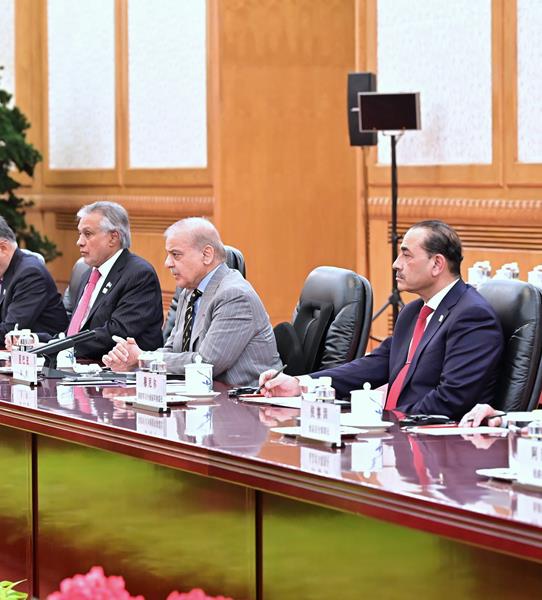
Prime Minister Muhammad Shehbaz Sharif meeting with the Prime Minister of the Peoples Republic of China Mr Li Qiang receiving at the Great Hall of the People in Beijing on 25 May 2026
PM Shehbaz with PM Li Qiang
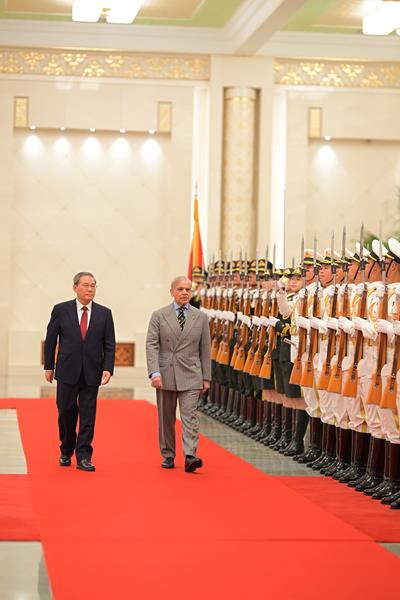
Prime Minister Muhammad Shehbaz Sharif was presented guard of honour upon arrival at the Great Hall of the People with Prime Minister of the Peoples Republic of China Mr Li Qiang, Beijing, 25 May 2026
This change was abundantly clear in the recent visit to China by the Prime Minister. The meeting with the Chinese Premier, Li Qiang, attendance at the Pakistan-China Third B2B Investment Forum and meetings with China's tech giants were evident symbols of this shift in the Pakistan-China cooperation away from the traditional economic cooperation toward the newer dimensions like technology, innovation, industry and strategic cooperation.
The atmosphere of the visit itself was meaningful. Pakistan and China were not just looking at the volume of trade or individual deals. Instead, they were discussing a convergence in vision and future-focused industries and development plans in an era of fast-changing technological and political global economy.
The PM during his talks with Premier Li Qiang in Beijing, stated that the Pakistan-China All-Weather Strategic Cooperative Partnership would continue to remain the centerpiece of Pakistan's foreign policy. The two sides expressed happiness with the gradual progress in the relationship and assured each other of support on each other's core issues. Although this is a standard boilerplate statement made at diplomatic negotiations, however the context of the visit itself suggests that the two sides are moving ahead with the relationship to a new plane.
That transition is evident in CPEC too. It has been evolving from a focus mainly on large-scale infrastructure and connectivity to a model that encompasses industrialization, modernization of agriculture, digitization, clean energy, science, and high technology cooperation. This trend itself mirrors the realities of global developments. In today’s world, economic power and influence do not solely rely on locations or routes of trade but on technology, innovation and digital connectivity.
It seems that the Pakistani leadership has taken notice of that too. Prime Minister Shehbaz Sharif stressed the necessity of bringing China's 15 th Five-Year Plan into sync with Pakistan's "Uraan Pakistan" development agenda in order to speed up the practical cooperation and long-term economic coordination between the two countries. It has become clear that the discourse from Islamabad is that it is an aspiring participant in Asia's technological and industrial future rather than restricted to traditional economic models.
An obvious manifestation of that increasing cooperation was evident during the Prime Minister's visit to the headquarters of the Alibaba Group in Hangzhou. Pakistani delegation was given a warm welcome by Chairman Joe Tsai where both sides saw the signing of number of strategic MOUs between Alibaba Group and Pakistani public/private sector institutions. The areas of cooperation are mainly the digitalization process, technological enhancement and developing further cooperation in emerging sectors.
Yet the importance of the meeting extended beyond business alone. Joe Tsai acknowledged Pakistan’s efforts toward regional and global peace and stability while also appreciating the government’s focus on technological innovation and creating an environment attractive for international investment. Such remarks reflected growing Chinese confidence in Pakistan’s direction and broader regional role.
As such, Alibaba's activity in Pakistan should be contextualised not simply as an isolated corporate venture, but as an extension of a broader pattern. Pakistani institutions and businesses are beginning to consider China not merely as the source of investment in physical infrastructure, but as a partner for enduring economic and technological development.
This macro-level transformation was in evidence during the entire visit. Repeated conversations revolved around digital transformation, science, connectivity, industrial growth and new technologies. The youth in Pakistan, with an increasing digital economy and growing tech sector, will increasingly become vital to its future ties with China.
The momentum was again deepened at the Pakistan-China Third B2B Investment Forum. Prime Minister Shehbaz Sharif proudly proclaimed that 30 percent of the MOUs between the two nations had "already converted to formal agreements," and that this was an unprecedented event. Most international investment forums are fraught with lofty declarations that never follow through. It seemed the priorities between Islamabad and Beijing remained constant: implementation, persistence, and results.
The symbolic aspect of the visit also counted. At the forum, Prime Minister Shehbaz Sharif remarked that Pak-China friendship is "deeper than the oceans and higher than the Himalayas," but with the launching of the space program, the friendship was now "touching the skies." While at any other time, such comments could easily be dismissed as nothing more than rhetoric, given recent circumstances, they pointed towards a relationship that has now entered sectors that would eventually define the future global economy.
Collaboration in space appears as one of the most direct illustrations. PM Shehbaz Sharif spoke of Pakistani astronauts’ selection to the China space station program as a demonstration of growing trust and cooperation in the strategic, high-technology areas. Collaboration in space is not just of scientific and technological interest but of symbolically great value: it is a show of trust, long-term perspective and readiness to work on extremely strategic, hi tech areas.
The same is true of discourse on artificial intelligence and emerging technologies. No nation will freely allow cooperation in strategic technology fields without genuine political trust. It seems that Pakistan and China are moving into a phase where they appear not only economically aligned but in how they perceive long term regional stability and development.
Of course, security remains a key element. The assurances given by Prime Minister Shehbaz Sharif regarding the safety and security of Chinese nationals and projects in Pakistan were still relevant, as a sustained economic partnership depends on confidence, stability, and continuity on both sides.
More broadly, the significance of the visit highlights where Pakistan is headed. For so long, the international dialogue with Pakistan was one of just security or economic crises and political instability. While all these remain present and accounted for, another narrative has been unfolding simultaneously.
Slowly but surely, Pakistan is moving towards its place in a globalized world of technology, connectivity, and economic partnerships. China’s constant faith in Pakistan provides more than just investment to Islamabad; it lends a sense of strategic credibility in a world which is becoming more fractured and unstable geostrategically.
The Pakistan-China relationship is not only about roads, ports and power plants anymore. Roads, ports, and power plants were and still are the basic building blocks of the relationship but it is clear that the collaboration is expanding into fields such as Artificial Intelligence, Digital Trade, Industrial modernization, clean energy, science and space technology.
That transition may ultimately define the next chapter of Pakistan-China relations. The first phase focused on building physical connectivity across regions. The next phase appears focused on building technological, industrial, and strategic connectivity for the future.
Photos accompanying this announcement are available at
https://www.globenewswire.com/NewsRoom/AttachmentNg/60eb09f0-644c-4431-9994-42a8d520018a
https://www.globenewswire.com/NewsRoom/AttachmentNg/e6a16230-f821-4587-b375-c132f467ea9e
Muhammad Subayyal
+923477195027
-
深圳麦当劳携手沙埔头社区,全国首个“麦麦主题社区”六一前夕温暖亮相深圳2026年5月30日 美通社 -- 六一儿童节来临之际,全国首个“麦麦主题社区”在深圳市福田区南园街道沙埔头社区正式揭牌亮相。该项目由深圳麦当劳与沙埔头社区联合2026-05-30
-
尚乘以3800万美元完成收购马来西亚上城景观富豪酒店巴黎、纽约和伦敦2026年5月30日 美通社 -- 尚乘集团(AMTD Group Inc.)、尚乘国际(AMTD IDEA Group,纽交所:AMTD;新交所代码:HKB)、尚乘数科(AMTD Digital Inc.,纽交所:H2026-05-30
-
“7好”王牌管吃管睡管运动!中国平安“服务年”发布平安居家服务品牌,升级主动健康管理服务5月29日,中国平安旗下平安人寿、平安好医生联合发布平安居家服务品牌,以2026“服务年”为契机,依托集团“综合金融+医疗养老”战略布局,围绕中国家庭“健康长寿”2026-05-30
-
尚乘成功完成珀斯丽思卡尔顿酒店收购 项目估值2.8亿澳元巴黎、纽约和伦敦2026年5月30日 美通社 -- 尚乘集团有限公司(简称“尚乘集团”)、尚乘国际(NYSE: AMTD;SGX: HKB)、尚乘数科(NYSE: HKD)及尚乘数科旗下子公司The Generation2026-05-30
-
第二届如是海沙滩公共艺术季启幕:以“共潮”之名,开启没有围墙的海边艺术盛宴秦皇岛2026年5月30日 美通社 -- 2026年5月26日,河北秦皇岛如是海度假村迎来了第二届沙滩公共艺术季的盛大开幕。本届艺术季以“共潮”(Together)为主题,将3公里原生沙2026-05-30
-
AMD股价暴跌17%创近9年之最,苏姿丰紧急回应:AI增速远超想象
-
Ledger 中国销售渠道说明:广州馨潇贸易有限公司官方直营渠道公示
-
江苏省脑机接口产业联盟在宁成立,麦澜德分享前沿成果
-
艾芬达入选国家知识产权强国建设示范创建对象:二十载长期主义,兑现每一份用户价值
-
Esentia宣布成功完成2033年到期的6.125%优先票据和2038年到期的6.500%优先票据的定价
-
中荷人寿北京分公司成功举办中荷创享家品牌发布暨协同发展启航仪式
-
华为系具身智能公司具脑磐石完成新一轮融资:对标JEPA,押注类脑智能的认知世界模型
-
慧启赣疆 聚势共赢丨慧友酒店集团江西品鉴会书写区域文旅融合新篇
-
电影《一秒》定档:2026年,活在这一秒
-
西藏斜视患儿寒假进京手术成功,千里护航点亮视觉未来