

March 10, 2026
Amsterdam, the Netherlands, and Las Vegas, USA – Royal Philips (NYSE: PHG, AEX: PHIA), a global leader in health technology, today highlighted how open, interoperable, AI-enabled platforms can help health systems connect continuous patient monitoring with diagnostic insights – bringing the patient story together across time and across specialties. By connecting clinical signals with diagnostic information, Philips enables care teams to move from fragmented data to a more continuous, actionable understanding of the patient.
Health systems are under unprecedented pressure, with rapidly growing data volumes stretching clinical capacity and contributing to care delays. Delays are often compounded by fragmented data across monitoring systems, imaging platforms, and clinical applications. Philips’ Future Health Index 2025 found that 77% of healthcare professionals have lost clinical time due to issues with incomplete or inaccessible patient data [1]. As providers look for ways to expand capacity without adding burden, AI is increasingly being adopted to help automate routine tasks and surface relevant insights sooner. Yet scaling AI requires trusted, interoperable, longitudinal data that can be contextualized in clinical workflows.
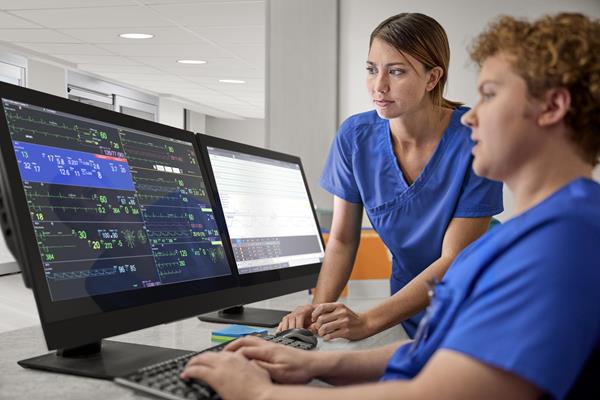
Nurses at central monitoring station
Philips’ platforms are designed to connect data, devices, and teams across care settings and diagnostic domains. By linking medical devices, patient monitoring systems, imaging platforms, and health information systems – including EMR and third-party technologies – Philips enables health systems to create a unified data foundation that supports continuous visibility and longitudinal insight across the enterprise. At HIMSS26, Philips is showcasing two core capabilities that help make this connected care intelligence possible: enterprise patient monitoring that enables longitudinal care intelligence, and Integrated Diagnostics that brings imaging and diagnostic data together across the enterprise.
“Care is longitudinal – it doesn’t begin or end at the hospital door,” said Julia Strandberg, Chief Business Leader Connected Care at Royal Philips. “When data is connected across environments, clinicians can see a more continuous patient trajectory rather than disconnected snapshots. That broader context helps reduce noise, improve situational awareness, and allow care teams to focus their time on what matters most: earlier intervention and better patient outcomes.”
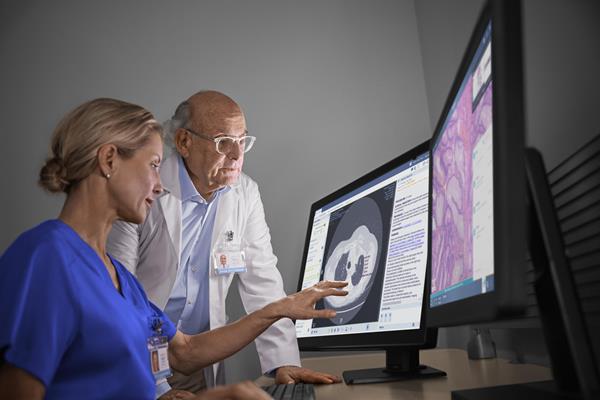
Integrated Diagnostics, radiology and pathology
Enterprise patient monitoring – enabling longitudinal care intelligence
Across the acute and post-acute continuum, clinicians need continuous visibility that travels with the patient. Philips is advancing longitudinal care intelligence by connecting enterprise monitoring with interoperable clinical data – so physiologic signals remain visible as patients move across care settings, including in high-acuity environments, during transitions of care, and after discharge.
By integrating medical devices and health information systems, including EMRs and a broad ecosystem of third-party devices, Philips helps create a connected data thread with central monitoring and surveillance workflows that support clinical decision-making across encounters and over time. This longitudinal foundation can help reduce workflow friction for care teams. Connected monitoring can also support strategies to relieve pressure on high-acuity environments by supporting safe, early discharge with oversight beyond the hospital walls.
Integrated Diagnostics – enterprise imaging integration to help reduce workload
A complete patient story also depends on diagnostics. Yet in many hospitals, diagnostic imaging data live in disconnected systems across radiology, cardiology, pathology, and other specialties. Clinicians often navigate multiple viewers, logins, and workflows to access the information needed to make decisions.
Integrated Diagnostics connects diagnostic systems, workflows, and AI applications so clinicians can access a more unified view of patient imaging and diagnostic data when decisions cannot wait. Philips’ HealthSuite Integrated Diagnostics portfolio provides a comprehensive suite of cloud-based solutions designed to connect data, integrate workflows, and embed AI across the diagnostic enterprise.
“Integrated Diagnostics isn’t about adding another tool – it’s about connecting the diagnostic enterprise, so clinicians aren’t forced to assemble the story themselves,” said Shez Partovi, Chief Innovation Officer and Chief Business Leader of Enterprise Informatics at Royal Philips. “When cardiology, radiology, pathology and other diagnostic domains come together on a connected foundation, teams gain a more unified view of the patient, time to diagnosis can drop, and intelligence can be embedded into everyday workflows in a way that truly scales.”
Philips’ platform approach is built with cybersecurity, privacy, and responsible AI practices at its core. Trust is foundational to enabling data liquidity across the enterprise, supporting longitudinal context, and scaling AI in ways that strengthen clinical decision-making while minimizing unnecessary complexity.
Experience Philips at HIMSS26
At HIMSS26, Philips is demonstrating how enterprise patient monitoring and Integrated Diagnostics can reduce fragmentation, accelerate insight, and support confident action across care environments and diagnostic workflows – while giving clinicians time back to deliver better care. For more information about solutions highlighted at HIMSS26, visit here.
[1] Philips Future Health Index 2025. Available at: philips-future-health-index-2025-report-building-trust-in-healthcare-ai-global.pdf
For further information, please contact:
Anna Hogrebe
Philips Global External Relations
Tel.: +1 416 270 6757
E-mail: anna.hogrebe@philips.com
About Royal Philips
Royal Philips (NYSE: PHG, AEX: PHIA) is a leading health technology company focused on improving people’s health and well-being through meaningful innovation. Philips’ patient- and people-centric innovation leverages advanced technology and deep clinical and consumer insights to deliver personal health solutions for consumers and professional health solutions for healthcare providers and their patients in the hospital and the home.
Headquartered in the Netherlands, the company is a leader in diagnostic imaging, ultrasound, image-guided therapy, monitoring and enterprise informatics, as well as in personal health. Philips generated 2025 sales of EUR 18 billion and employs approximately 64,800 employees with sales and services in more than 100 countries. News about Philips can be found at www.philips.com/newscenter.
Attachments
-
Port-Laredo宣布在德克萨斯州拉雷多举行PORT-LAREDO全球贸易峰会‘26* USMCA更新、新关税、物流和符合性“新标准”等关键主题 得克萨斯州拉雷多2026年3月11日 美通社 -- 拉雷多港被公认为美国和墨西哥之间陆上贸易的重要枢纽,今日宣2026-03-11
-
SK keyfoundry成功开发450V-2300V SiC平面MOSFET工艺平台,斩获1200V新品订单,正式开启SiC业务全面布局* 成功开发450V-2300V SiC平面MOSFET工艺平台,确保高可靠性与良率竞争力 * 启动为新客户开发1200V SiC MOSFET,加速SiC化合物半导体代工业务进程 韩国首尔2026年2026-03-11
-
白雪香槟Piper-Heidsieck重返奥斯卡®盛典: 共庆影坛辉煌传承加利福尼亚州好莱坞2026年3月11日 美通社 -- “本世纪获奖最多的香槟酒庄”*白雪香槟(Piper-Heidsieck),华丽回归好莱坞最具传奇色彩的盛事之夜。2026年3月15日,品牌将作2026-03-11
-
全城昼夜创意盛宴:Vivid Sydney 2026计划正式发布悉尼2026年3月11日 美通社 -- 为期23天的Vivid Sydney(缤纷悉尼灯光音乐节)将于5月22日(星期五)至6月13日(星期六)举行。本届活动通过Vivid Light(缤纷灯光)、Vivid Music2026-03-11
-
让智能在实验中进化:恩和科技发布 SAION AI - 面向生物制造的物理智能平台旧金山和杭州2026年3月11日 美通社 -- 当人工智能正以其强大的认知与生成能力深刻重塑着数字世界时,另一个更具突破性的力量已经迈入物理世界物理人工智能,一个能够2026-03-11
-
AMD股价暴跌17%创近9年之最,苏姿丰紧急回应:AI增速远超想象
-
慧启赣疆 聚势共赢丨慧友酒店集团江西品鉴会书写区域文旅融合新篇
-
电影《一秒》定档:2026年,活在这一秒
-
西藏斜视患儿寒假进京手术成功,千里护航点亮视觉未来
-
年度盛典|卓兴半导体2025年度总结表彰暨 2026 年迎新晚会
-
科技赋能 生态协同,登途集团车辆资产管理运营模式助推行业提质增效
-
公元地暖构建“产品+施工+服务”全维保障网,兑现50年温暖承诺
-
VCI Global 投资组合公司 Reveillon Group 与 NOWWA Coffee 达成战略合作,共同开拓马来西亚市场
-
易事特回应光伏逆变器国抽问题:完成全流程整改,产品均达国标要求
-
Agencia Comercial拟斥逾1.2亿美元跨界布局AI基础设施